Friday, April 30, 2010
Wednesday, April 28, 2010
Beijing 2010: 2011 Hyundai Accent debuts as Verna across the Pacific
Hyundai's fluidic sculpture design language has now spread to the smallest vehicle in its lineup, and the new sub-compact slated to take the place of the aging Accent was unwrapped on the floor of the Beijing Motor Show. We've been seeing spy shots of the next generation Accent for some time and it very clearly follows the same design path as its big brother the Sonata.
The little sedan, badged the Verna outside the U.S., has the same rounded coupe-like greenhouse and rising crease up the sides. Inside the Verna/Accent definitely has a more attractive, higher-quality feel than the current model, although calling it up-scale would be slightly disingenuous. We'll have to wait and see what kind materials the North American model gets before making a decision.
Power is slated to come from either a 1.4- or 1.6-liter inline-four, producing 106 horsepower and 120 hp, respectively, with a standard five-speed manual gearbox or four-speed automatic. Expect the U.S. version to come packing the larger four-pot when it goes on sale early next year.
Wednesday, April 21, 2010
Kia Forte awarded IIHS 'Top Safety Pick'
Much like parent company Hyundai, Kia has been working hard to revive its brand image. New products like the Soul and Forte have been relatively well received so far, and with new stunners like the 2011 Sportage and Optima on the way, Kia should benefit from a healthy boost in sales. But strip away the sleek new designs and clever interior packaging, and you'll find that Kia's core value of crafting extremely safe vehicles is still holding strong, especially now that the 2010 Forte sedan has been named a Top Safety Pick by the Insurance Institute for Highway Safety.
The Forte received ratings of "Good" (the highest achievable) in front, side, rear and rollover impact crash tests – something that safety-minded buyers will surely appreciate. What's more, this gives the Forte more ammo to compete head on with the Honda Civic and Toyota Corolla, its two main competitors, which have also been dubbed as Top Safety Picks by IIHS. Curiously, only the sedan was mentioned in the IIHS study, so we can't say if this prestigious honor carries over to the two-door coupe Koup.
Monday, March 8, 2010
Production Hyundai i-flow planned for 2011; showcar previews diesel hybrid system and new eco ideas
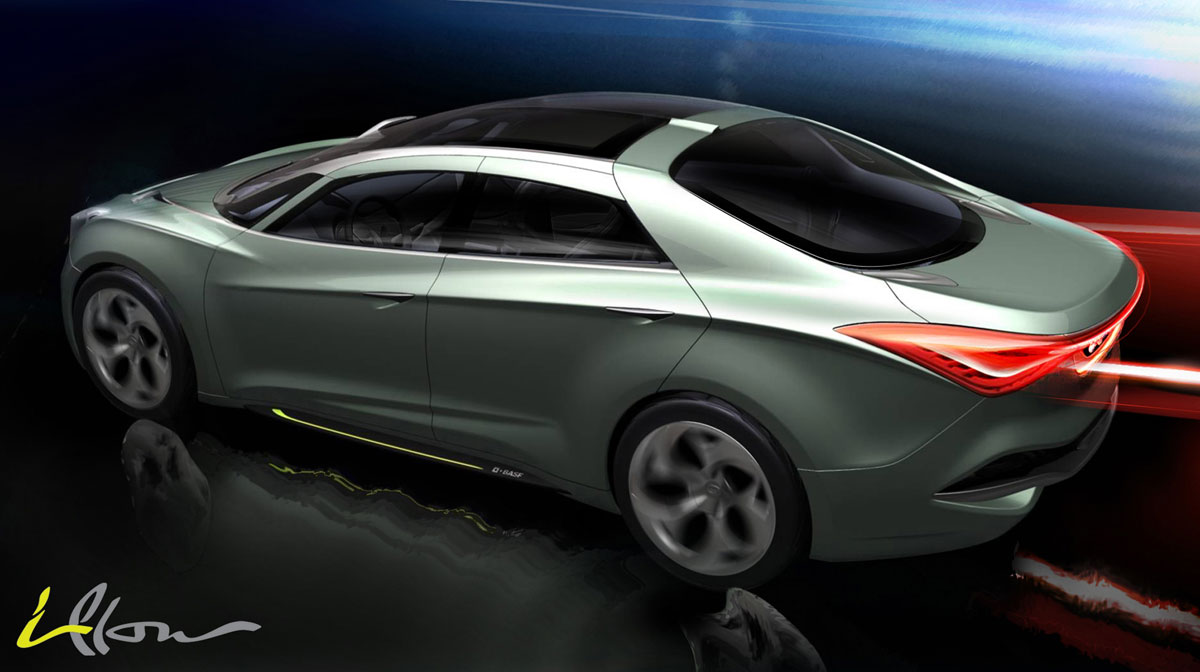
The Hyundai i-flow is one of the significant concept cars at Geneva, not just because it looks dramatic, but because under that heavily sculpted skin is a range of latest tech that could appear in Hyundai’s next generation of cars. Powering the i-flow is the company’s first diesel-electric hybrid powertrain consisting of a U2 1.7-litre oil burner with two-stage turbocharging and Hyundai’s lithium ion-polymer battery. Coupled to a six-speed, dual-clutch transmission, the drivetrain is capable of 33.3 km/l and a low CO2 output of 85g/km.
The i-flow is also a test bed for new energy harvesting ideas, ranging from a flexible solar panel roofing to a thermo-electric generator developed in partnership with leading chemical company BASF. One such idea is thermal engine encapsulation, which ensures that the engine reaches optimum operating temperature more quickly by retaining heat when the car is idle. Hyundai says that this translates into fuel savings and emissions cuts of 5% during summer and up to 9% in winter. The thermo-electric generator meanwhile recaptures energy from hot exhaust gases and converts it to electrical energy to help power auxiliary systems.
Designed at Hyundai’s European studio in Russelsheim, the i-flow sports the firm’s “fluidic sculpture” design language. With an overall length of 4,780 mm and a 2,800 mm wheelbase, the i-flow is a Honda Accord sized D-segment contender that is set to hit the market in 2011. It remains to be seen how much of the i-flow’s styling is retained for production, but things look promising with the recent Korean realisation that advanced design is as important as making competent cars.
Live pictures from Geneva and official images are after the jump!
Monday, February 15, 2010
Hyundai i-flow Concept to debut at Geneva 2010
The sketch above previews the Hyundai i-flow concept, which will make its world debut at the Geneva show at the end of this month. Hyundai says this concept will preview a future D-segment competitor – but really, is it time for a new D-segment competitor so soon when the Sonata has just been revealed? The Sonata already has a coupe-like roofline so it would be quite overkill for them to do a “Passat CC CC” with another take on a D-segment car.
This is just a hunch but it could be possible that what Hyundai meant in its press release as D-segment is different from what we normally consider as D-segment cars. In the US, what we call D-segment cars are CD-segment cars. The Camry is a CD car, while Toyota’s D car is the Avalon. Hyundai had a model like that – the Azera, and it was even sold here in Malaysia. The Azera was first launched in 2005 and it’s about time for a 5-year lifecycle full replacement model to arrive!
This new concept car could be slotted in between the Sonata and the Genesis as Hyundai’s most expensive front wheel drive executive car (taking the place of the Azera) before we start to enter Genesis rear wheel drive territory. But then again I could be wrong and this is really a “double CC” version of the Sonata.
The same press release also says this new i-flow concept will be used by chemical company BASF (there’s a good chance you use BASF products in your car everyday – they make petrol additives too) as a platform to showcase some technology such as lightweight materials, and solar cells.
New Hyundai Sonata and Tucson coming in April!
Hyundai Sime Darby will be a very busy company in 2010, and the first launches we can expect from them this year is the introduction of the new Sonata YF and Tucson SUV, which is scheduled for April. Both cars will be imported CBU from Korea, and our source has also revealed the variants that will be brought in.
The sixth-generation Sonata, codenamed YF, will come with two Theta II engines – a 163 bhp/198 Nm 2.0-litre and a 176 bhp/228 Nm 2.4-litre, mirroring the engine options of its D-segment Japanese rivals. Not only the Sonata’s figures compare very well with its competitors, it also has a six-speed automatic gearbox (Accord and Camry 2.4 have five forward ratios) which is self-developed and claimed to be “maintainence free”.
The Tucson SUV will also ship with these two engines and the six-speed auto ‘box. If you want 4WD, opt for the 2.4-litre model, as the 2.0-litre Tucson will be front-wheel drive only. Hyundai’s Theta II, which is a development of the GEMA world engine, is 10kg lighter than its predecessor, more frugal, cleaner and comes with Dual CVVT. The latest GDI direct injection engines won’t reach our shores however, due to below par fuel quality.
Spec levels for these two cars will be competitive and prices will undercut their immediate rivals, which we take as the Honda CR-V for the Tucson, Accord and Camry for the Sonata. You may have noticed the Arab number plates on these pictures; they were snapped this afternoon as we have been test driving the new Hyundais in Muscat, Oman. Unfortunately, we cannot share our impressions with you yet as the story is embargoed, but do stay tuned for updates as the launch date nears. Let’s just say for now that these new entries have great showroom appeal and are very decent to drive
Saturday, February 13, 2010
Top Luxury Cars - The Maruti Suzuki Ritz and Hyundai i10
The result was Hyundai sells at least 8,000 units of the i10 on an average every month. Indian small car market leader could not let such a market slip away form its finger. It launched Maruti A-star which was designed to rival the base versions of the Hyundai i10 while the Maruti Suzuki Ritz was meant to bit the share from the top end version. But Hyundai i10 has stood its ground and continues to pack all other hatchbacks to the lower ranks.
Let us take a compare the two cars Hyundai i10 and the Maruti Suzuki Ritz for what they stand.
On the performance, Hyundai i10 comes with two types of powertrains including Kappa engines and Ritz is powered by the new K12M engines. The smaller capacity 1.1Litre engines borrowed from Santro is a very capable power source. The other 1.2Litre Kappa engine is brilliant in performance and fuel economy. It delivers healthy 78.8 bhp while the Ritz with 1.2 Litre engine generates 84 bhp. Both engines offer a peak torque of 11.4 Kgm. When one compares the power to weight and torque to weight parameters, the Ritz is a big loser. The heavy body construction adds a full 170 kgs over what the i10 weights. This means the Hyundai i10 will offer quicker acceleration and sharp curves. Even when the cars are compared during the 0-60 km/h clock- the Hyundai i10 lands a few seconds earlier than Ritz. The Hyundai i10 surges comfortably ahead of the Maruti Suzuki Ritz.
On the ride and handling front, Ritz scores higher points than the i10. Built on the legendary Swift hatchback platform, Maruti Suzuki Ritz sports a taller roofline, a wider front end and a heavy rear end which helps balance the car during sharp curves. Ritz is a notch better than the i10 on agile handling parameter. The steering wheel in the Ritz offers good feel of the road and allows driver to feel in control of the vehicle. But drivers who believe that they have to zip through traffic like a cheetah, should go for the i10 as it is more agile owing it its lighter weight. At high speeds both cars display awesome stability.
On the design and interiors, Maruti Suzuki Ritz is more likely to rival the Hyundai i20. The tall and bulkier Ritz, comes with larger headlamps and wider front end, which translates to an attention grabbing exterior style. It has an utilitarian appeal complete with all the Maruti Suzuki design cues. The Hyundai i10 has a more contemporary design with pear drop shaped headlamps and grille that exudes power. It has the radical styling (like the swift) which will change the way hatches will look in the near future.
The interiors in Maruti Suzuki Ritz are spacious like the Swift. There is a tachometer integrated into the dashboard and twin dial instrument cluster is visually pleasing. Due to its tall roofline it offers an airy headroom which can accommodate adults over 6 ft tall. The rear seats offer a spacious legroom. The Hyundai i10 sports a modern feel. The controls on the dash are logically placed. The fine quality of the materials and the clean blend of dual of equipments and styles gives a feel of an upscale car. The in-car entertainment is on of the best in its class. The visibility from the driver's seat is excellent as the driver get a full forward view. The rear seat can be slightly cramped for large adults.
To read more interesting car articles, visit Carazoo.com Article Source: http://EzineArticles.com/?expert=V_Divya |
Saturday, February 6, 2010
Thursday, February 4, 2010
Top Luxury Cars - The 2010 Hyundai Tiburon
The great asset to the Tiburon is its exterior the model scored middle range for its exterior design style. The interior in the vehicle is more comfortable and reasonably accommodating for the front seat passengers. According to the news stated by the Detroit News, "the vehicle feels and looks terrific". The sport model Tiburon was rated well in the crash tests conducted by the government and featured with a wide range of safety features like the front side air bags.
The recent model in Tiburon was offered in two types of engines - the 2.0 liter 4-cylinder that generates 138 horse power of energy and torque of 136 lb ft and the 2.7 liter V6 engine produces 172 horse power of energy and torque of 181 lb ft. The estimated EPA with the Tiburon is 20 miles per gallon in the city and 28 miles per gallon on highway. Now, the 2010 Hyundai Tiburon will be a much improvised and revamped version of the earlier generation, so let us wait and watch will it really serve as the much needed leap from failure to success?
Article Source: http://EzineArticles.com/?expert=Ryan_Jeffreys
Wednesday, February 3, 2010
Hyundai i30 pitures